
KUON continues its ongoing dialogue with C.P. Company, revisiting archival outerwear through traditional Japanese craft. Following a previous project that brought hand-stitched sashiko techniques to technical nylon jackets, the brand now shifts focus toward natural dyeing practices rooted in centuries-old methods.
The latest collaboration centers on repurposed C.P. Company garments, reworked on Amami Ōshima, a subtropical island in southwestern Japan known for its heritage dyeing culture. Here, the Kanai Kōgei studio applies organic processes that transform high-performance jackets into objects shaped by time, environment, and manual intervention.
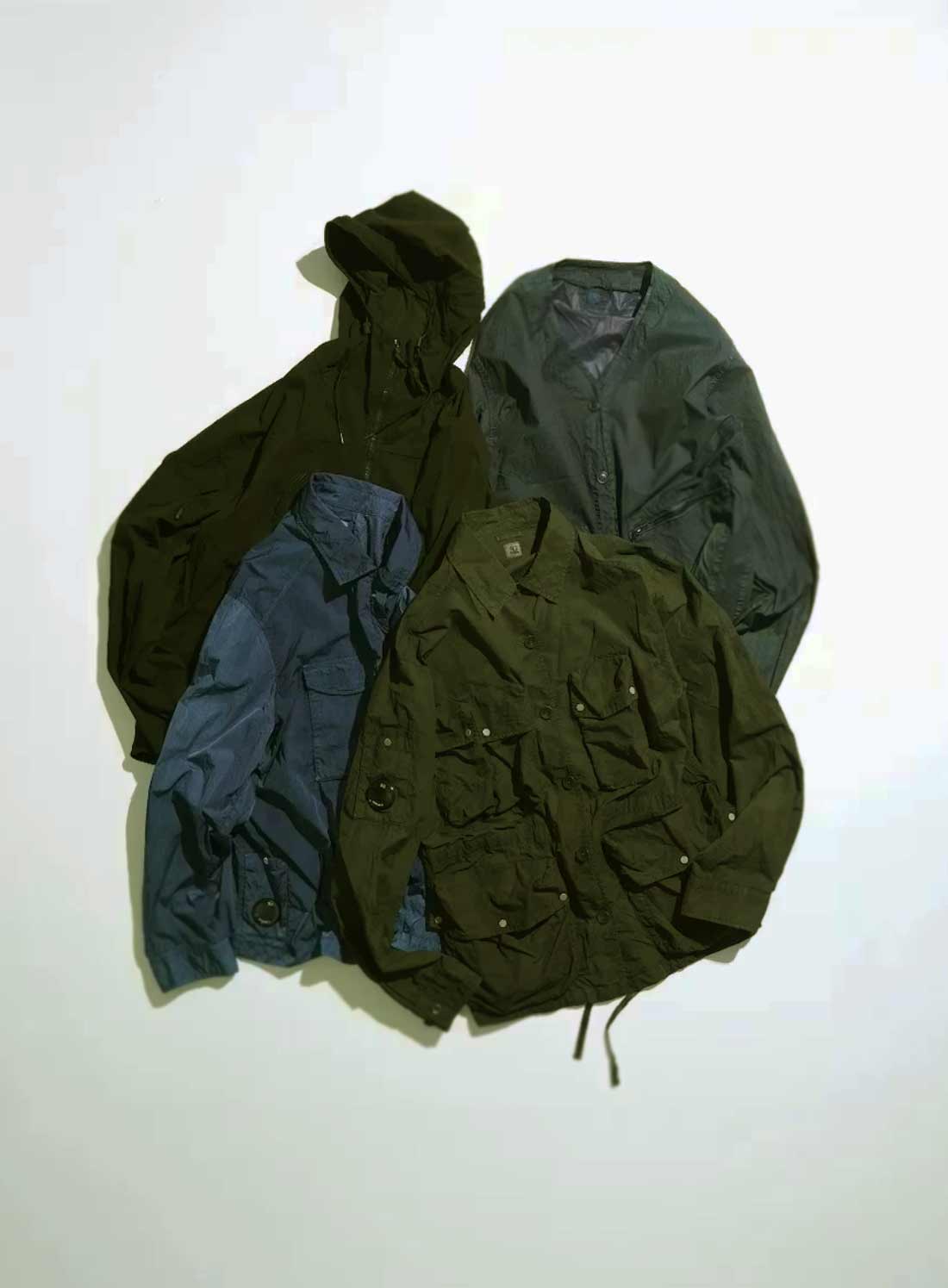
One direction of the collection explores deep earthy browns achieved through tannins derived from local sharinbai trees. The fabric is then immersed in mud fields, a process that balances and settles the tone while introducing subtle irregularities across each piece. These variations create a surface that reflects the unpredictability of natural dye absorption, resulting in a patina that is entirely individual to every jacket.
Another series focuses on indigo dyeing, using pigments extracted from the leaves of the Indian indigo plant. The warm climate of the island intensifies the saturation, producing a vivid blue that contrasts with the more muted earthy tones of the brown-dyed garments.
C.P. Company’s involvement adds another layer of significance. The brand has a long history of innovation in garment dyeing, particularly through the pioneering work of Massimo Osti in the 1970s, who helped define its technical identity. This collaboration therefore represents a rare moment where that legacy is interpreted through external traditional methods rather than in-house experimentation.
The outcome is a collection that merges technical sportswear with artisanal processes. Rather than relying on synthetic precision, the garments are shaped by natural materials, environmental conditions, and human touch.
Released in Tokyo through Isetan Shinjuku, the project highlights a shared interest in transformation. Despite their contrasting origins, both approaches aim to give each garment a distinct surface identity, defined by texture, depth, and time rather than uniform production.